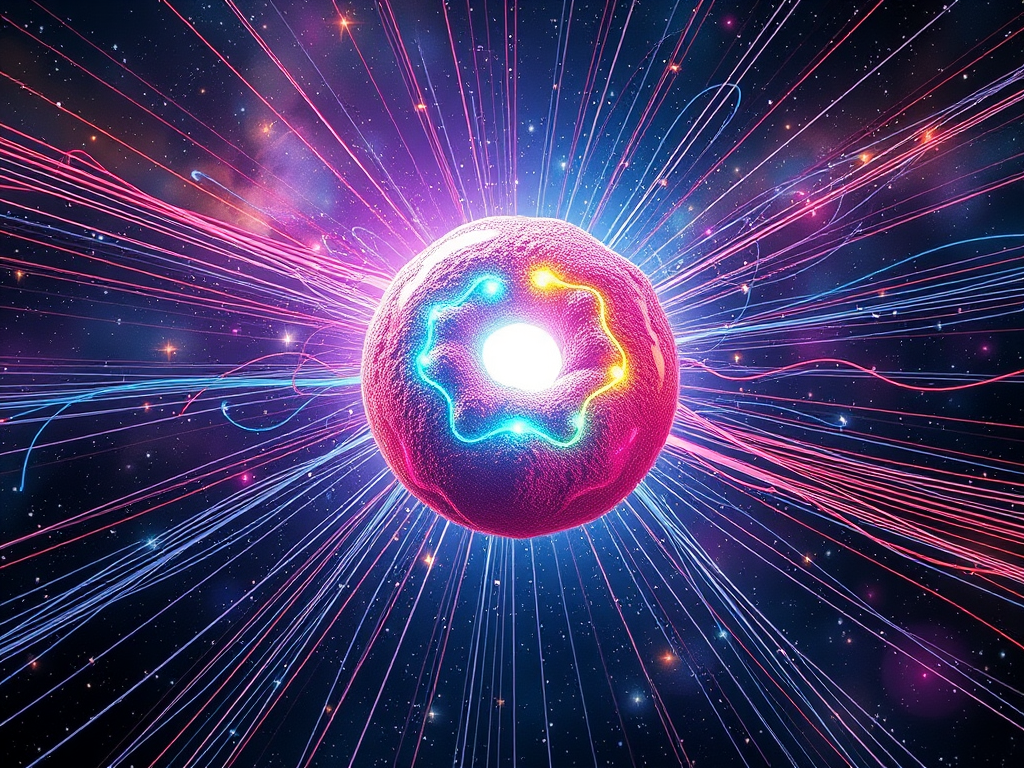
Usually, this space is reserved for scale-up architectures, AI trends, or evaluating the next big seed round. But sometimes, you have to zoom out. Way out. Past the code, past the market caps, right to the edge of reality itself.
Recently, I went down a fascinating rabbit hole about String Theory, Multiverses, and the true mathematical nature of our universe. The concepts are so mind-bending—yet logically structured—that it felt like reading the ultimate source code of existence. It was a conversation too good not to share.
So, let’s step away from the IDE for a moment. Here is a Q&A breakdown of how the cosmos might actually be built.
Q: What is our universe, really? Are we just floating in empty space?
Not exactly. To understand the modern view of the cosmos, we have to look at M-Theory and Brane Cosmology.
Imagine our 3D universe not as infinite emptiness, but as a surface—a membrane, or “Brane.” We are a 3D slice existing within a much larger, 11-dimensional environment called the Bulk (or hyperspace).
Think of it like a billiard table inside a massive room. The billiard balls (which represent our matter and light) are constrained to roll only on the green felt of the table. They can’t fly up into the air of the room. We are effectively trapped on this 3-Brane.
Q: If we are trapped, what are we actually made of?
Everything boils down to incredibly tiny, vibrating loops of energy called strings.
Think of it in Python terms: these strings are the absolute primitive data types of reality. You can’t break them down into anything smaller. There aren’t different “materials” either. Just like passing different parameters to a function changes its output, the specific way a single string vibrates determines whether it manifests in our world as an electron, a photon, or a quark.
If you pack enough of these one-dimensional strings densely together, they form the very fabric of our 3D Brane.
Q: Can anything escape our universe and travel through the Bulk?
Yes, but it depends on the “Velcro” rule.
Strings come in two types:
- Open Strings (Matter & Light): These look like cut rubber bands. Their endpoints act like Velcro and are mathematically forced to stay attached to our Brane. That’s why we can’t shine a flashlight into the 11th dimension. The photons are glued to our surface.
- Closed Strings (Gravitons): These are perfect, closed loops. They don’t have endpoints, so they don’t have Velcro. The hypothetical particle of gravity—the graviton—is a closed string.
Because gravitons aren’t tethered to our universe, they can slip off our Brane and travel freely through the higher dimensions of the Bulk. This explains why gravity seems so incredibly weak compared to electromagnetism; most of its force is literally leaking out into other dimensions!
Q: So, are there other universes out there in the Bulk?
The math strongly suggests it. There could be countless other Branes floating in the Bulk alongside ours.
Sometimes, these universes can interact. If a neighboring universe gets close enough to ours in the Bulk, its gravitons could cross the empty space and reach us. We wouldn’t be able to see this parallel universe, but we would feel its gravitational pull. Many physicists suspect that this “phantom gravity” is exactly what we currently call Dark Matter.
Q: What if a new universe is born? Doesn’t creating matter from nothing violate the laws of physics?
This was the biggest mental hurdle for me, but the answer is a masterpiece of cosmic accounting: The Zero-Energy Universe.
When extreme conditions (like the singularity inside a black hole) cause spacetime to rupture and spawn a “baby universe,” it doesn’t actually violate the conservation of energy.
The universe has two ledgers:
- Positive Energy: All the matter, light, and mass (the assets).
- Negative Energy: The gravitational pull (the liabilities).
As the baby universe rapidly expands, it creates massive amounts of new matter. But simultaneously, the expansion creates an equally massive gravitational field. The two perfectly cancel each other out. The net energy of the entire system remains exactly zero. It’s the ultimate cosmic startup: infinite scale, with absolutely zero initial capital required.
Q: If we can’t see the Bulk or these extra dimensions, how do physicists even test this?
By writing complex code. Since we can’t build physical detectors large enough to catch a graviton, modern physics relies heavily on AI and deep learning simulations.
Researchers define the 11-dimensional Bulk mathematically as a high-dimensional tensor. Our universe is represented as a lower-dimensional slice within it. By setting the strict laws of physics as the loss function, neural networks optimize the geometry, twisting and warping the simulated spacetime until the model stabilizes. We are literally rendering the unseen architecture of reality to see if the math holds up.
After wrapping my head around 11 dimensions, intersecting branes, and gravitons, logging off and going for a 20-kilometer long run feels like the only logical way to process it all.
If this sparked your curiosity and you want to add some mind-expanding ideas to your reading pile, I highly recommend picking up Warped Passages by Lisa Randall or Parallel Worlds by Michio Kaku.
See you in the Bulk.



 APILama